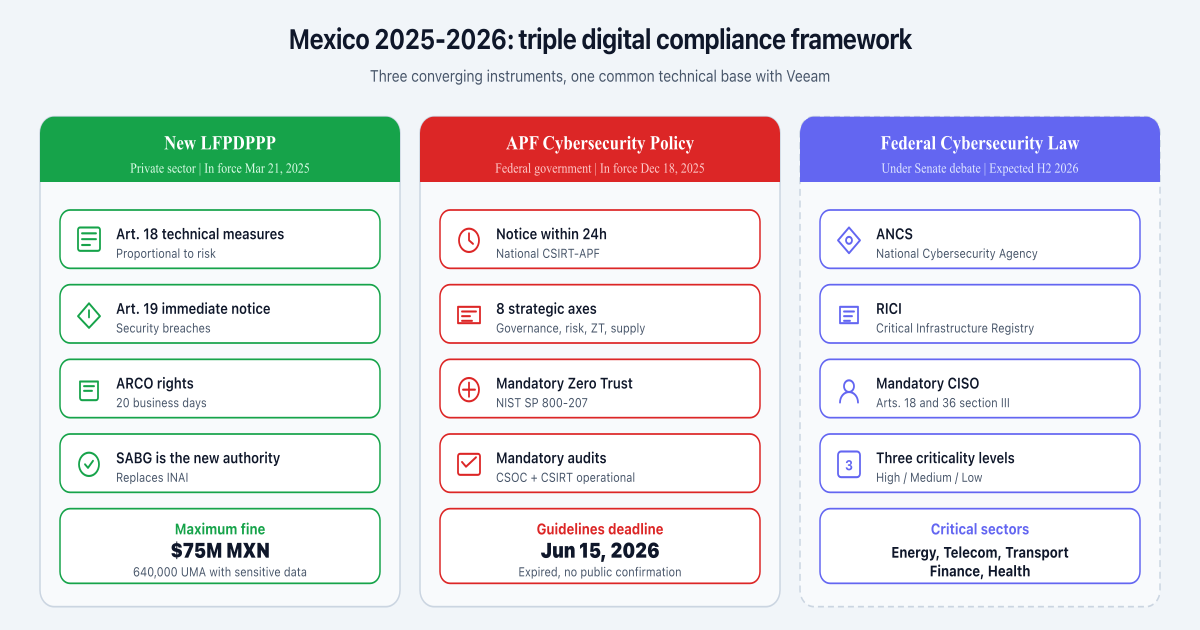
In less than twelve months, between March and December 2025, Mexico completely flipped the digital regulatory board. Three instruments published in the Official Gazette of the Federation rewrite the rules for any organization that processes personal data or operates critical infrastructure in Mexican territory. And the fourth one is still coming, the Federal Cybersecurity Law, expected in the second half of 2026. If your organization operates in Mexico and you still think this is a “next quarter” topic, you are already late.
Important note: This post is a technical interpretation from a Solutions Architect Nerd perspective, not legal advice. The definitive legal analysis for any organization must be performed together with its legal team and, when applicable, with external counsel specialized in Mexican personal data protection and cybersecurity.
Introduction#
For fifteen years, the 2010 LFPDPPP was the only relevant Mexican framework for private sector data protection, with INAI as the supervisory authority. That ended. The constitutional reform of November 28, 2024 dissolved seven autonomous bodies, including INAI, and transferred its powers to the Anti-Corruption and Good Governance Ministry (SABG). On top of that new institutional base, the new LFPDPPP was published on March 20, 2025, taking effect the following day.
Nine months later, on December 17, 2025, the Digital Transformation and Telecommunications Agency (ATDT) published in the Official Gazette the General Cybersecurity Policy for the Federal Public Administration, based on the National Cybersecurity Plan 2025-2030. And in parallel, the Federal Cybersecurity Law (LFC) bill submitted by senators Luis Donaldo Colosio Riojas (MC) and Lucía Trasviña Waldenrath (Morena) in April 2025 is advancing through the legislative process, with an expected enactment in the second half of 2026.
Three converging frameworks, one common goal: bringing Mexico up to the GDPR standard, but with stricter notification deadlines (24 hours for the government sector, versus the 72 hours of GDPR) and with fines that can reach 75 million Mexican pesos for an aggravated violation involving sensitive data. For IT areas, this changes the game: technical controls over data and systems become subject to external audit, and the documentation that supports each control becomes evidence that the SABG, the ATDT, and eventually the upcoming National Cybersecurity Agency can request at any time.
In this context, the Veeam Platform is a key component to implement and evidence several of the technical principles demanded by the three frameworks, particularly those related to confidentiality, integrity, availability, operational resilience, and incident response. In this post we will see how each obligation maps to specific capabilities of Veeam Backup & Replication, Veeam ONE, Veeam Recovery Orchestrator, Veeam Threat Hunter, and the rest of the stack.
The Mexican triple framework#
Before going down to technical controls, it helps to understand where we stand on the regulatory calendar as of June 2026.
| Framework | Applies to | Status | In force |
|---|---|---|---|
| New LFPDPPP | Private sector | In force | March 21, 2025 |
| APF General Cybersecurity Policy | Federal Public Administration | In force | December 18, 2025 |
| National Cybersecurity Plan 2025-2030 | APF and national strategic framework | In force | December 2025 |
| Federal Cybersecurity Law (LFC) | Whole territory | Under Senate debate | Expected H2 2026 |
To this we add the General Law for the Protection of Personal Data Held by Obligated Parties (LGPDPPSO), also renewed in March 2025, covering the public sector regarding personal data processing. This means that a Mexican government entity, right now, is simultaneously bound by the LGPDPPSO, the APF General Cybersecurity Policy, and the National Plan, and when the LFC is approved a fourth regime will be added.
What changes with the new LFPDPPP versus the 2010 version#
The new LFPDPPP is not a superficial change. It is INAI gone, a new authority, and fines that now actually hurt.
INAI dissolution and transfer of powers to the SABG#
INAI was the autonomous supervisory body. Its dissolution was decreed by the constitutional reform of November 28, 2024 and materialized with the publication of the decree in the Official Gazette of March 20, 2025, with the formal operational shutdown of INAI on May 9, 2025. As of March 21, the Anti-Corruption and Good Governance Ministry took over the powers of investigation, audit, and sanction regarding private sector personal data protection, while the functions of transparency and access to public information moved to a new body named Transparencia para el Pueblo, created by the same reform.
For your organization this means one concrete thing: the authority that can audit you is not the same one from five years ago, and the criteria are still being written. The SABG concentrates investigation powers that were previously distributed, which in practice speeds up sanctioning procedures.
Graduated sanctions with real deterrent effect#
The new LFPDPPP keeps the structure of administrative sanctions in Units of Measure and Update (UMA), but the ranges were updated and doubled in the case of sensitive data. The UMA value in force since February 1, 2026 is 117.31 Mexican pesos per day (published by INEGI after a 3.69% increase over 2025).
Standard violations (Arts. 58-64): from 100 to 160,000 UMA, equivalent to between 11,731 and 18,769,600 pesos (approximately between USD 640 and USD 1.02 million).
Aggravated violations: up to 320,000 UMA, equivalent to 37,539,200 pesos (approximately USD 2.05 million).
Sensitive data: fines double when the violation involves sensitive data, reaching up to 640,000 UMA, equivalent to 75,078,400 pesos (approximately USD 4.10 million).
Custodial sentence: between 6 months and 5 years in prison for anyone who processes personal data deceptively or by taking advantage of the data subject’s error to obtain an economic benefit. If it sounds harsh, it is: the criminal sanction goes beyond the legal entity and lands directly on the individual responsible for the processing.
Change in the definition of “person”#
The previous law referred to a “natural person” as the data subject. The new LFPDPPP removes that qualifier and simply says “person”, which opens the door to interpretations that could include legal entities as holders of data protection rights in certain contexts. Although Mexican legal doctrine is still digesting this change, the practical effect is that the universe of protected subjects expands.
Reinforced consent and privacy notice#
Consent must be free, specific, and informed, and any modification or addition to the purposes declared in the privacy notice requires new consent from the data subject. The privacy notice must now explicitly distinguish between necessary purposes and voluntary purposes. This has a direct impact on document management systems and CRMs, but also on backups, since backed-up data preserves the consent framework valid at the moment of capture.
Biometric and behavioral data as a high-risk category#
Biometric data (fingerprints, facial recognition, voice, iris) and behavioral data (usage patterns, browsing paths, reaction times, persistent geolocation) are treated as high-risk categories, subject to reinforced obligations of security, proportionality, and transparency. For any organization using biometric access control, facial authentication, or behavioral analytics, this translates into additional technical obligations that also apply to the backups of those systems.
Right to object to automated decisions#
The new LFPDPPP explicitly incorporates the data subject’s right to object to the automated processing of their data when that processing significantly affects their interests, rights, or freedoms and is carried out without human intervention. This right parallels Art. 22 of GDPR and requires documenting automated credit scoring processes, dynamic pricing algorithms, machine learning based fraud detection systems, and any other automated mechanism that produces legal or significant effects on the data subject.
Breach notification#
Art. 19 establishes the obligation to immediately notify security breaches that affect the data subject’s economic or moral rights. The law does not set a specific deadline in hours (unlike GDPR with its 72 hours), but “immediate” in Mexican administrative practice is interpreted as a reasonable timeframe that the authority will evaluate case by case, where the recommendation is not to exceed the 72-hour mark used as an international benchmark.
When the LFC is approved, this deadline could become harmonized: the National Cybersecurity Plan already set 24 hours for critical incidents in the APF, and the current LFC bill (Art. 26) establishes a “timely and proportionate” notification whose concrete deadline in hours will be defined in secondary regulation, possibly between 24 and 72 hours depending on the criticality of the regulated subject.
ARCO rights: what stays and what gets reinforced#
Mexico keeps the ARCO rights (Access, Rectification, Cancellation, Objection) as the backbone of data subject protection, with a maximum response deadline of 20 business days. This matters because the “ARCO” acronym was born in Mexico with the 2010 LFPDPPP and survives in the new law, but with two adjustments that increase the technical pressure on IT:
- Cancellation is interpreted more broadly, requiring the controller to demonstrate that the data effectively stopped being processed, including in backups and test or development environments.
- Objection is reinforced with the right against automated decisions, described in the previous section.
This creates a concrete technical tension with backup immutability, which we will address in a dedicated section later in this post.
Technical tensions that change with the new law#
Three concrete changes require revisiting the backup and disaster recovery architecture:
- Confidentiality extended to all third parties: the controller must implement controls that ensure that anyone involved in the processing, including backup providers and cloud services, maintains confidentiality. This translates into stricter clauses in provider contracts, and in practice forces a review of the RBAC model over backups.
- International transfers with documented justification: transfers without consent only proceed in exhaustively listed cases (legal compliance, corporate groups with binding policies, contract execution, justice). For backup architectures using Veeam Data Cloud, Veeam Vault, or Veeam Data Cloud for Microsoft 365 in regions outside Mexico, this requires clear documentation of the transfer basis and of equivalent security measures.
- Right to object to automated decisions: if your organization runs machine learning models over personal data, you must be able to demonstrate human review mechanisms when the right to object is exercised.
The APF General Cybersecurity Policy (December 2025)#
On December 17, 2025, the ATDT published in the Official Gazette the General Cybersecurity Policy for the Federal Public Administration, based on the National Cybersecurity Plan 2025-2030. It took effect the following day, December 18, and applies to all agencies, decentralized bodies, and entities of the APF, except SEDENA, SEMAR, and CNI regarding national security matters.
The 8 strategic axes#
The Policy is organized into eight axes that any Mexican CISO should know:
- Governance, regulatory framework, and compliance. A homogeneous framework of rules and federal supervision under ATDT authority.
- Risk management and operational resilience. Structured risk assessment, service continuity, and resilience of digital platforms.
- Protection of critical infrastructure and technological assets. Reinforced protection across networks, clouds, and essential government services.
- Prevention, detection, and incident response. Continuous monitoring, early warning, and mandatory reporting to the National CSIRT-APF within less than 24 hours.
- Identity, access, and Zero Trust. Implementation of NIST SP 800-207: no trust by default for users, devices, or networks.
- Supply chain and trusted third parties. Evaluation of providers, integrators, and external services with auditable control criteria.
- Technical capabilities, human talent, and culture. Sustainable strengthening of institutional capabilities and human risk metrics.
- Innovation, maturity, and continuous improvement. Periodic indicators, measurable maturity levels, and strategic review every two years.
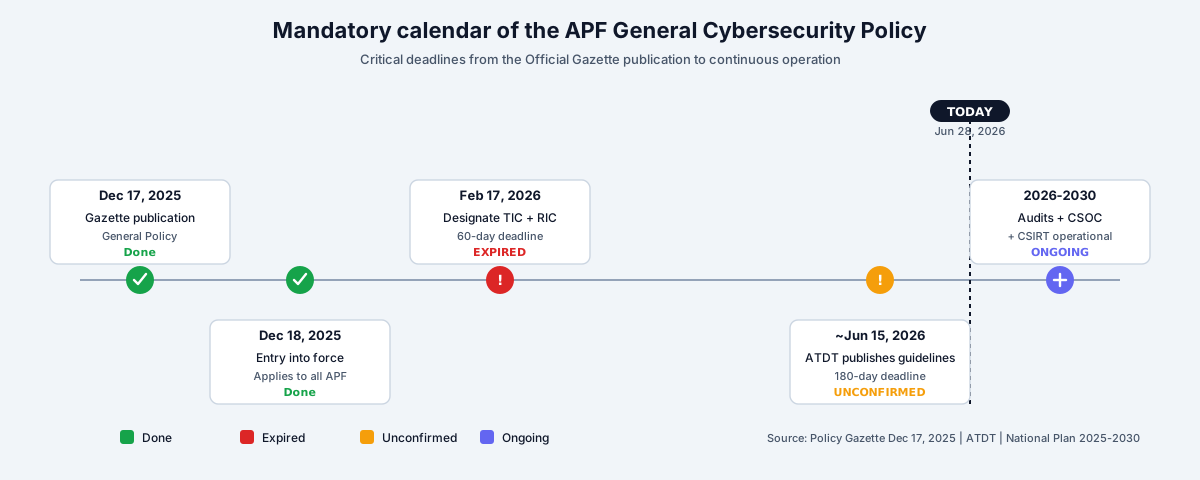
Critical deadlines of the APF calendar#
| Date | Milestone | Responsible | Status as of June 2026 |
|---|---|---|---|
| Dec 17, 2025 | Official Gazette publication of the General Policy | ATDT | Done |
| Dec 18, 2025 | Entry into force | All APF agencies | Done |
| Feb 17, 2026 | Designate Institutional Lead (TIC) and Institutional Cybersecurity Officer (RIC), notifying the ATDT (60-day deadline) | Each agency | Expired |
| ~Jun 15, 2026 | ATDT publishes technical guidelines, compliance criteria, and official formats (180-day deadline) | ATDT | Expired, no public confirmation |
| 2026-2030 | Compliance audits, maturity assessments, operation of the CSOC and CSIRT | DGCiber + ATDT | Ongoing |
The 60-day deadline to designate TIC and RIC expired on February 17, 2026. Any agency that has not complied is in formal breach of the Policy. If you still have not designated TIC and RIC, the conversation is no longer “when do we do it”, it is “how do we justify the delay”. The 180-day deadline for the ATDT to publish the technical guidelines, compliance criteria, and official formats expired around June 15, 2026. As of this publication there is no public confirmation in the Official Gazette or in ATDT channels that those guidelines have been issued, so it is worth verifying directly before assuming either state. When they come out, that is when the concrete specifications of controls, metrics, and reporting formats will become known, including the standardized catalog of minimum controls and the institutional maturity model that were announced.
Notification to the National CSIRT-APF within 24 hours#
Axis 4 of the Policy imposes an obligation that is stricter than GDPR: critical incidents must be reported to the National CSIRT-APF within less than 24 hours of detection. This CSIRT, specialized for the government sector and operated under ATDT direction, acts as the central instance for reception, analysis, and response coordination for cyberattacks that compromise systems, information, or public services.
For IT this means that the detection, triage, escalation, and notification chain has to be tuned to the point of being able to close in less than one calendar day. It is not an internal response time target, it is a regulatory deadline that the ATDT can audit.
Mandatory Zero Trust#
Axis 5 establishes the mandatory implementation of the Zero Trust model per NIST SP 800-207: no user, device, or network is trusted by default. This collides head-on with many current architectures based on internal trust zones, well-defined perimeters, and backups accessible from broad administrative networks. In most Mexican data centers it means redesigning segmentation, privileged access, and the backup console itself. The migration to Zero Trust in backup infrastructure has concrete technical implications that we will see when mapping to Veeam.
The National Cybersecurity Plan 2025-2030#
The National Plan is the strategic document that frames the APF Policy and lays the conceptual foundations for the upcoming Federal Cybersecurity Law. Developed by the ATDT and the General Directorate of Cybersecurity, with support from the Inter-American Development Bank (IDB), it defines the first transversal cyberdefense policy in Mexico’s history.
Three elements of the Plan are critical to understand where the Mexican ecosystem is heading:
National Cybersecurity Operations Center (CSOC). The operational unit that will coordinate detection and incident response at the federal level. Its creation is on the roadmap and full operation is expected within the 2027-2028 horizon.
Specialized APF CSIRT. The incident response team already in operation, in charge of receiving notifications from federal agencies within the 24-hour deadline, coordinating containment, and issuing sector-specific alerts and playbooks (for example, for ransomware and DDoS).
National Cybersecurity Council. The inter-institutional governance body, with representation from the private sector, academia, and civil society. It will also be the framework for the private sector to participate in threat intelligence sharing with the government.
The Plan reports figures that justify the urgency: 324 billion attempted cyberattacks in Mexico during 2024 (according to the Fortinet Global Threat Landscape Report 2025), and a 78% increase in cyberattacks over previous years. Mexico is today among the most attacked countries in Latin America. This is not fear marketing, it is the baseline on which the rest of the framework is built.
And the pressure did not ease in 2026. In January, the breach of 25 federal government agencies tested the APF posture barely a month after the Policy took effect. And in the financial sector, the Bank of Mexico registered more cybersecurity incidents between January and May 2026 than in the previous four years combined. The regulatory framework is not being built in the abstract, it is being built while the attacks are already inside.
The Federal Cybersecurity Law (LFC): what is coming in 2026#
The LFC bill was submitted to the Senate on April 30, 2025 by senator Luis Donaldo Colosio Riojas (MC) together with senator Lucía Trasviña Waldenrath (Morena). It is worth highlighting that it is not an opposition bill: it has the backing of the majority parliamentary group, which increases the probability of approval. The expectation among Mexican legal analysts is that the LFC will be enacted in the second half of 2026.
There is also a factor pushing from the outside: in March 2026, voices in the Senate stated that there are conditions to approve the Cybersecurity Law before the end of the year, explicitly tying the legislation to Mexico’s commitments under the USMCA (T-MEC). The trade agreement with the United States and Canada includes obligations on digital matters and data protection, and the USMCA review turns the LFC into more than a domestic matter: it is also a card Mexico plays before its trade partners. For a company with cross-border operations, this means that compliance with the Mexican framework stops being optional even before the law is published.
Source: everything that follows about the LFC is based on the full text of the bill published in the Senate Gazette (official PDF, April 30, 2025), the official Senate communiqué, and the technical-legal analyses from specialized firms (QMA, Acedo Santamarina, BASHAM, Global Suite Solutions, Scitum). The specific deadlines in hours and exact fine amounts will be defined in the secondary regulation published once the law is approved.
Proposed structure#
The bill has 64 articles and 9 transitory provisions. It creates two key institutions:
National Cybersecurity Agency (ANCS). A civilian decentralized body (that does not encroach on the competences of SEDENA, SEMAR, or CNI), with a Director General proposed by the Executive and ratified by the Senate. The requirements are Mexican nationality, age between 35 and 70, and a minimum of 10 years of experience in cybersecurity or critical information infrastructure. Key powers: managing the RICI, requesting access to systems during significant incidents through a reasoned resolution, proposing sanctions, and issuing technical guidelines.
Critical Information Infrastructure Registry (RICI). Mandatory registration for operators in critical sectors. The criteria to consider an asset “critical” include service volume, sectoral interdependencies, economic or health impact, and the processing of sensitive data. The priority sectors are energy, telecommunications, transport, the financial system, and health.
Three criticality levels#
The LFC proposes classifying obligated subjects into three levels:
| Level | Subjects | Main requirements |
|---|---|---|
| High | Critical Information Infrastructure (ICI) + strategic Essential Service Operators | Continuous risk assessment, annual audits, immediate notification, mandatory sectoral CERT |
| Medium | Non-strategic Essential Service Operators | Internal policies, periodic assessment, notification within reasonable deadlines |
| Low | Regulated subjects of smaller scale | Basic measures, simplified notification |
Reclassification occurs every two years or upon significant changes in the regulated subject.
Mandatory CISO#
Arts. 18 and 36 section III of the bill establish that all five categories of obligated subjects must designate a “specialized cybersecurity liaison”. For critical infrastructure operators, this is formally enforceable with a documented record and a reporting line to the board of directors.
Sanctions (Arts. 59-64)#
Four types, without fixed amounts in pesos (which will come in the secondary regulation):
- Warning. For minor violations and first occurrence.
- Fine proportional to the damage or risk caused.
- Temporary suspension of critical operations.
- Disqualification from providing essential services, in cases of serious recidivism.
Incident notification in the LFC#
The current bill speaks of “timely and proportionate” notification (Art. 26) and reserves the concrete deadline for the secondary regulation. The definitive deadlines in hours are not yet fixed in the text of the bill, so any specific figure on this point will be an estimate until the regulation is published. What we can anticipate is that the harmonization will seek coherence with the 24-hour deadline already in force for the APF and with the 72-hour international standard of GDPR.
Alignment with the Budapest Convention#
The LFC proposes to harmonize the criminal types with the Budapest Convention on Cybercrime of the Council of Europe of 2001. This includes harmonizing offenses (illegal access, interference with data and systems, computer fraud, online child pornography), legal interception with procedural guarantees, and international cooperation in cyber investigations. It is important to clarify that Mexico has not yet ratified the Convention, remaining an observer country, unlike Chile, Argentina, Colombia, Peru, Brazil, Costa Rica, Panama, Paraguay, and the Dominican Republic, which have ratified it. The approval of the LFC, by harmonizing the criminal definitions, would represent a relevant technical step toward an eventual formal accession.
Comparison: Mexico versus Chile and GDPR#
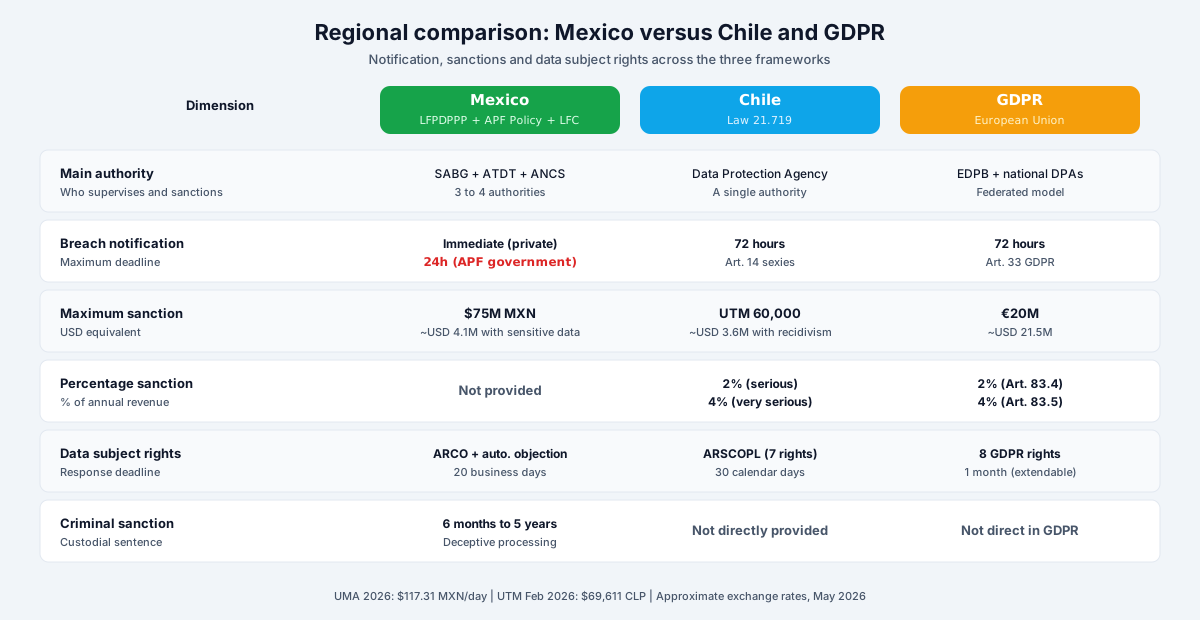
| Dimension | Mexico (LFPDPPP + APF Policy + upcoming LFC) | Chile (Law 21.719) | GDPR (EU) |
|---|---|---|---|
| Main authority | SABG (private) + ATDT (government) + ANCS (upcoming) | Personal Data Protection Agency | EDPB + national DPAs |
| Status | LFPDPPP in force, APF Policy in force, LFC under debate | Full effect Dec 1, 2026 | In force since 2018 |
| Breach notification (private) | Immediate (LFPDPPP Art. 19) | 72h (Law 21.719 Art. 14 sexies) | 72h |
| Breach notification (government) | 24h to the National CSIRT-APF | n/a unified | n/a unified |
| Absolute maximum sanction | 75M MXN (~USD 4.1M) with sensitive data | 1.392M CLP (UTM 20,000), triplicable to 4.2M (UTM 60,000) | 20M EUR |
| Revenue-percentage sanction | Not provided (only fixed UMA) | 2% (serious), 4% (very serious) | 2% / 4% |
| Data subject rights | ARCO + Objection to automated decisions | ARSCOPL (Art. 4-13) | 8 individual rights |
| ARCO response deadline | 20 business days | 30 calendar days | 1 month |
| Mandatory DPO | Compliance Officer (Art. 29 LFPDPPP) | Yes, for mass or sensitive processing | Yes, in defined cases |
| Criminal sanction | Yes (6 months to 5 years prison) | Not provided in Law 21.719 | Not direct (yes in national laws) |
| Mandatory Zero Trust | Yes (APF) | Not explicit | Not explicit |
The big difference with Chile is that Mexico does not have a revenue-percentage sanction (which Law 21.719 and GDPR do), but it compensates with the automatic doubling for sensitive data and with the criminal sanction. The big difference with GDPR is the institutional fragmentation of Mexico (three to four different authorities depending on the applicable regime) versus the more consolidated EU model.
ARCO Cancellation versus backup immutability#
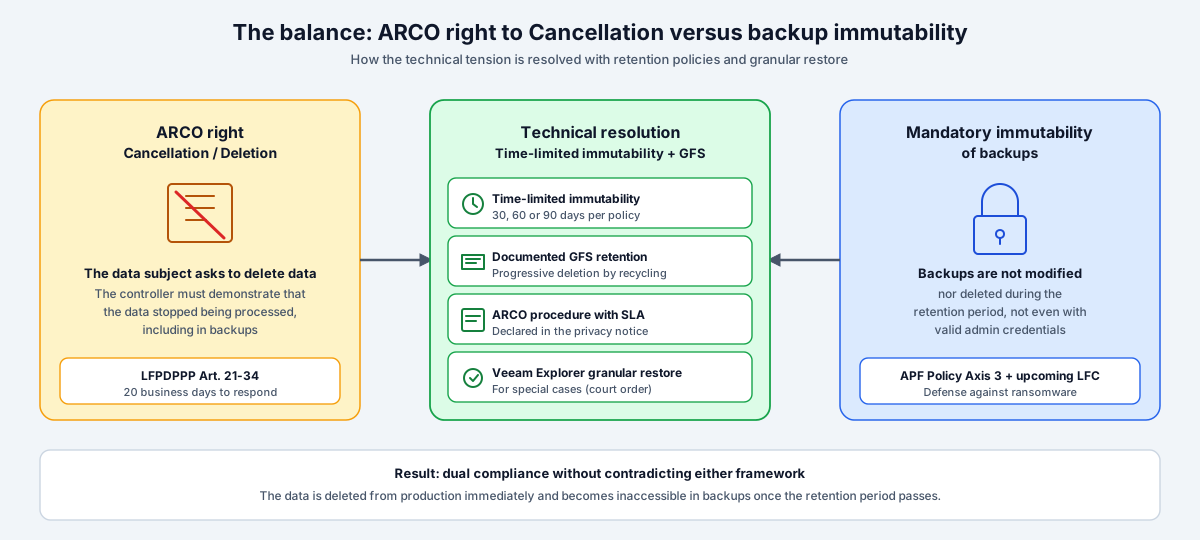
This is the tension where legal and IT bump heads. It is worth getting it right.
On one side, the new LFPDPPP reinforces the ARCO right to Cancellation, requiring that when the data subject requests the deletion of their data, the controller demonstrates that the data effectively stopped being processed, including in backups.
On the other side, the APF General Cybersecurity Policy, the National Plan, and the upcoming LFC push toward mandatory immutability of backups as a defense against ransomware: backups that cannot be modified or deleted, not even by administrators with valid credentials.
How do you resolve this apparent contradiction? With a technical architecture that combines time-limited immutability with well-designed retention policies:
- Time-limited immutability: backups are not immutable forever, but during a well-defined period (for example, 30, 60, or 90 days) aligned with internal retention policies and with the deadlines of the applicable laws.
- Documented GFS (Grandfather-Father-Son) retention policies: when a data subject exercises their right to Cancellation, the data is deleted from production systems immediately. In the backups, the data becomes inaccessible once the retention period passes, which is formally documented in the ARCO request response procedure.
- Documented ARCO procedure with SLA: the internal procedure must be formally documented and must explain to the data subject that deletion materializes progressively as backups recycle, within the retention period declared in the privacy notice.
- Granular restore for special cases: when it is necessary to delete a specific piece of data inside an immutable backup (for example, by court order), Veeam Explorer allows restoring the backup, identifying the data to delete, and creating a new version of the backup without that data, leaving a complete audit trail.
The SABG and Mexican courts have not yet generated specific case law on this point, but the technical balance described above is aligned with the European GDPR criterion (the Google Spain case) and with international practice.
Veeam technical mapping to Mexico obligations#
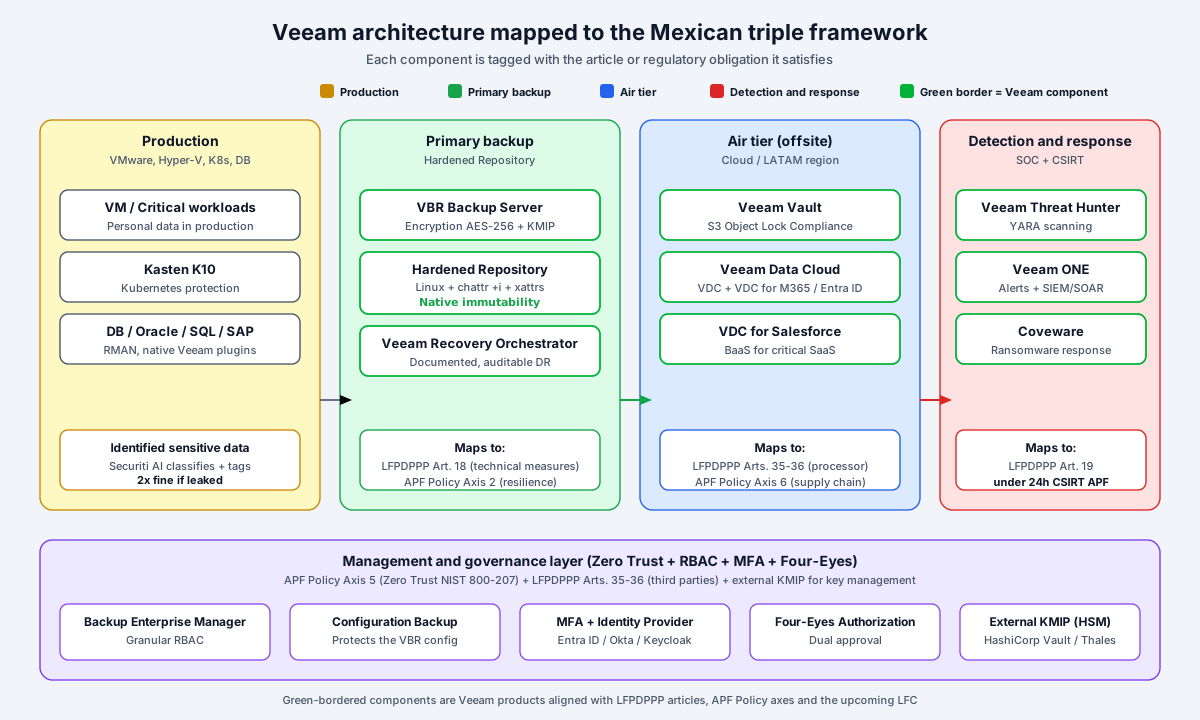
Below is the concrete mapping of each article or obligation to a specific technical capability of the Veeam Platform.
Art. 18 LFPDPPP, Axis 3 APF Policy: technical, physical, and administrative measures#
Obligation. The controller must implement administrative, technical, and physical measures proportional to the level of data sensitivity and to the potential risk.
Veeam.
- Hardened Repository on Linux for on-premises repositories with native immutability based on
chattr +iand filesystem extended attributes. It cannot be altered, not even by root, during the immutability period. - Veeam Vault for the air tier (offsite) in the cloud with S3 Object Lock in Compliance mode, satisfying the 3-2-1-1-0 rule already known across the industry.
- AES-256 encryption at rest and in transit, managed with Veeam Backup Enterprise Manager or integrated with external KMS via KMIP (HashiCorp Vault, Thales CipherTrust, AWS KMS, Azure Key Vault).
- Full auditing in Veeam ONE with detailed logging of every administrative operation, extended log retention, and periodic export for regulatory evidence.
Art. 19 LFPDPPP, Axis 4 APF Policy: detection and incident notification within 24 hours#
Obligation. Immediate notification (LFPDPPP) or within less than 24 hours (APF) of incidents that compromise personal data or critical systems.
Veeam.
- Veeam Threat Hunter with a YARA scanning engine over backups for early detection of IoCs, run continuously over backups before restores.
- Coveware (part of Veeam after the 2024 acquisition) for ransomware intelligence, variant identification, and negotiation guidance, in the case of an active incident.
- Veeam ONE with configurable alerts and connectors toward SIEM platforms (Splunk, Microsoft Sentinel, IBM QRadar, Elastic) and SOAR. The notification playbook to the National CSIRT-APF runs in an automated way from the SOAR, integrating the incident data reported by Veeam ONE.
- Inline malware detection integrated into the backup process, identifying suspicious patterns in the live data flow, before the backup closes.
Axis 5 APF Policy: Zero Trust#
Obligation. Implementation of NIST SP 800-207. No trust by default for users, devices, or networks.
Veeam.
- Role-Based Access Control (RBAC) granular in VBR, Veeam ONE, and Veeam Backup Enterprise Manager. Each role with the minimum necessary privileges.
- Multi-Factor Authentication (MFA) mandatory for all administrative consoles, integrated with corporate identity providers (Microsoft Entra ID, Okta, Keycloak).
- Four-Eyes Authorization for critical operations (backup deletion, immutability policy changes, mass restores), requiring approval from two different administrators before execution.
- Veeam Backup Configuration backup encryption to protect the configuration of the backup server itself.
Sensitive data (LFPDPPP, fines doubling up to 75M MXN)#
Obligation. Technical reinforcement for biometric and behavioral data, with fines that double in case of non-compliance.
Veeam.
- KMIP with external HSM (HashiCorp Vault, Thales) to manage encryption keys outside the backup server domain, with periodic rotation and selective revocation.
- Classification and tagging of backups that contain sensitive data, integrable with Securiti AI (acquired by Veeam in December 2025) for automatic discovery and classification of sensitive personal data.
- Double-level encryption for the air tier: AES-256 encryption at the backup level + S3 repository encryption with Object Lock + cloud provider KMS.
DSPM with Securiti AI: the component that closes the LFPDPPP compliance loop#
The new LFPDPPP creates three technical problems that no traditional backup solves on its own: knowing where the personal data is, classifying it correctly between sensitive and non-sensitive (because the fine doubles), and responding within 20 business days to ARCO requests for Access and Cancellation. This is exactly the domain of Data Security Posture Management (DSPM), and it is the reason why the acquisition of Securiti AI by Veeam in December 2025 stops being a corporate detail and becomes an architecturally relevant component for any Mexican organization.
Securiti AI capabilities mapped to the Mexican framework:
- Multi-cloud and on-premises Data Discovery. Securiti discovers personal data in structured repositories (relational databases, data lakes) and unstructured ones (file shares, SharePoint, OneDrive, S3, Azure Blob, GCS) and in critical SaaS systems (Microsoft 365, Salesforce, Workday, ServiceNow). For the LFPDPPP this translates into maintaining an automatically updated Processing Registry, not a manual one.
- Automatic classification with AI. The engine identifies more than 200 types of personal data and categorizes by sensitivity. It applies specific rules for biometric and behavioral data that the new LFPDPPP marks as high-risk categories, tagging them so that backup and retention policies apply reinforced treatment.
- Privacy Ops for ARCO automation. The rights of Access, Rectification, Cancellation, and Objection require a response within 20 business days. Securiti automates the flow: the data subject exercises their right, the engine identifies all repositories where the data lives, generates the Access report, or executes the Cancellation with audit traceability. Without this layer, complying with ARCO over thousands of annual requests is operationally unfeasible.
- Data Flow Mapping for international transfers. Securiti visually maps how personal data flows in and out of Mexico. This covers the obligation to document international transfers (Arts. 35-36 LFPDPPP) with evidence that the SABG can request during a supervisory process.
- AI Trust and Data Security Posture. With the new LFPDPPP requiring human intervention in significant automated decisions, Securiti documents which personal data feeds machine learning models, what purposes they have, and issues alerts when a new data flow enters a model without documentation.
- Compliance mapping against LFPDPPP, LGPDPPSO, GDPR, Brazil LGPD, and other frameworks. It generates gap analysis reports and compliance posture by regulatory framework. An organization operating in Mexico, Brazil, and Chile can use a single control point for the three regimes.
Why this matters for your backup architecture. Without DSPM, your backup platform protects the data but does not know what type of data it protects. That means you apply the same retention and immutability policy to the backup of a file server containing anonymous resumes and to the backup of a CRM system containing customers’ biometric data. With DSPM, backup policies become data-aware: workloads containing sensitive data get reinforced retention, encryption with a dedicated HSM, and automatic ARCO procedures, while workloads with non-personal data keep standard policies. This is what separates a real compliance architecture from a declaration of good intentions.
Data processor (Arts. 35-36 LFPDPPP), Axis 6 APF Policy (supply chain)#
Obligation. Data processors (cloud providers, MSPs, integrators) must assume obligations equivalent to those of the controller.
Veeam.
- Veeam Data Cloud as Veeam’s SaaS platform, where the customer retains control of the data and of the encryption keys.
- Veeam Data Cloud for Microsoft 365 for backing up Exchange Online, OneDrive, SharePoint, and Teams, particularly relevant for Mexican companies operating with Microsoft 365 whose personal data falls under the new LFPDPPP.
- Veeam Data Cloud for Entra ID and Veeam Data Cloud for Salesforce for critical SaaS where sensitive employee and customer information resides.
- Auditable evidence of the processor’s operations over the data: exportable logs, compliance reports, provider certifications (ISO 27001, SOC 2 Type II, ISO 27017, ISO 27018).
Axis 2 APF Policy: operational resilience and continuity#
Obligation. Structured risk management, service continuity, and resilience.
Veeam.
- Veeam Recovery Orchestrator (VRO) for DR plans that are documented, automatically tested, and with auditable executive reports. It allows complying with the “proven operational resilience” principle of Axis 2.
- Scheduled non-disruptive restore testing (SureBackup) that validates the recoverability of each backup, generating auditable evidence for the SABG and for the ATDT.
- Documented RTO and RPO per critical application, with metrics exportable toward corporate GRC platforms.
ARCO Cancellation with immutable backups#
Obligation. Delete personal data when the data subject exercises their right to Cancellation, without weakening backup immutability.
Veeam.
- Veeam Explorer for granular restore: recovering a specific object (email, database row, file) without restoring the entire backup.
- Documented procedure that explains the progressive deletion through the natural recycling of backups once the retention period is met, communicated to the data subject in the privacy notice.
- Selective restore with re-encryption in special cases (court order), where deletion materializes immediately.
Practical checklist for Mexican CISOs#
For the private sector (LFPDPPP in force)#
- Privacy notice updated distinguishing necessary and voluntary purposes.
- Formal designation of the Compliance Officer (Art. 29).
- Inventory of automated processing with significant effects on data subjects, and documented objection procedures.
- ARCO procedure with a 20-business-day SLA, integrated with backup systems.
- Inventory of international transfers and documented legal basis for each one.
- Breach notification procedure to the SABG with internal deadlines of no more than 72 hours.
- Implemented technical measures: encryption at rest and in transit, backup immutability, granular RBAC, MFA on all administrative consoles, exportable logs.
For the Federal Public Administration (Policy in force)#
- TIC and RIC designation notified to the ATDT (should have been done before Feb 17, 2026).
- Implementation of controls of the 8 axes in an initial phase.
- Design of the notification procedure to the National CSIRT-APF within less than 24 hours.
- Zero Trust roadmap with a specific NIST SP 800-207 implementation schedule.
- Initial evaluation of providers and supply chain.
- Maturity diagnosis against the axes of the National Plan.
- Preparation for the technical guidelines that the ATDT will publish around June 15, 2026.
For LFC preparation (expected H2 2026)#
- Preliminary diagnosis of whether the organization will fall into the Critical Information Infrastructure category.
- Identification of the CISO or specialized cybersecurity liaison with a technical and governance profile.
- External audit based on ISO 27001 or NIST CSF as a benchmark, to reach the RICI with evidence.
- Documented and tested incident response plan, with tabletop exercises at least once a year.
- Backup segregation strategy for critical assets: restricted access, encryption by default, periodic testing.
Frequently asked questions#
Who does each of the three Mexican frameworks apply to?
The new LFPDPPP applies to the private sector and has been in force since March 21, 2025. The General Cybersecurity Policy applies to the Federal Public Administration (except SEDENA, SEMAR, and CNI on national security matters) and has been in force since December 18, 2025. The upcoming Federal Cybersecurity Law will apply across the whole territory, with a focus on critical infrastructure operators in sectors such as energy, telecommunications, transport, the financial system, and health, and is expected in the second half of 2026.
What is the deadline to report a security breach in Mexico?
For the private sector, LFPDPPP Art. 19 requires immediate notification, and in practice the recommendation is not to exceed the 72-hour international benchmark. For the Federal Public Administration, the General Cybersecurity Policy requires notification to the National CSIRT-APF within less than 24 hours of detection. The LFC bill speaks of “timely and proportionate” notification, with the exact deadline in hours still pending definition in secondary regulation.
What is the maximum sanction of the new LFPDPPP?
Aggravated violations reach up to 320,000 UMA, equivalent to roughly 37.5 million Mexican pesos. When the violation involves sensitive data, the fine doubles to 640,000 UMA, around 75 million pesos (about USD 4.1 million). The law also provides a custodial sentence of 6 months to 5 years for anyone who processes data deceptively or by taking advantage of the data subject’s error.
Is Zero Trust mandatory in Mexico?
Yes for the Federal Public Administration: Axis 5 of the General Cybersecurity Policy establishes the mandatory implementation of Zero Trust per NIST SP 800-207, with no trust by default for users, devices, or networks. For the private sector it is not yet an explicit legal obligation, but the upcoming Federal Cybersecurity Law will probably incorporate it. In Veeam this translates into granular RBAC, mandatory MFA on all consoles, and four-eyes authorization for critical operations.
How is the right to Cancellation reconciled with the mandatory immutability of backups?
With an architecture that combines time-limited immutability (for example 30, 60, or 90 days) with well-documented GFS retention policies: the data is deleted from production immediately and becomes inaccessible in backups once the retention period is met, all declared to the data subject in the privacy notice. For special cases such as a court order, Veeam Explorer allows a granular restore, deletes the specific data, and generates a new backup version with a complete audit trail.
How does Veeam help comply with the Mexican triple framework?
Veeam Data Platform provides immutability with Hardened Repository and Veeam Vault (S3 Object Lock), AES-256 encryption at rest and in transit managed via KMIP, RBAC and MFA for Zero Trust, Veeam Recovery Orchestrator for proven operational resilience, Veeam Threat Hunter and Coveware for detection and incident response, and Veeam ONE for exportable auditing and notification within less than 24 hours via SIEM/SOAR integration.
Official resources and references#
Legal texts
- New LFPDPPP - Official Gazette March 20, 2025
- LGPDPPSO - Official Gazette March 20, 2025
- APF General Cybersecurity Policy - Official Gazette Dec 17, 2025
- National Cybersecurity Plan 2025-2030 - ATDT
- LFC bill - Senate April 2025
- UMA 2026 value - INEGI
Technical standards
- NIST SP 800-207 (Zero Trust Architecture)
- NIST SP 800-61 (Computer Security Incident Handling Guide)
- Budapest Convention on Cybercrime
Veeam
- Veeam Data Platform
- Veeam Backup & Replication
- Veeam ONE
- Veeam Threat Hunter
- Veeam Recovery Orchestrator
- Veeam Vault
- Veeam Data Cloud
- Veeam Data Cloud for Microsoft 365
- Veeam Data Cloud for Entra ID
- Veeam Data Cloud for Salesforce
- Coveware
- Securiti AI
Related posts#
- Chile Law 21.719: technical compliance manual with Veeam
- Veeam Hardened Immutable Repository
- Veeam Hardened Repository on RHEL
- Veeam Capacity Tier on Oracle Cloud Object Storage
- Kasten RBAC multi-tenant multi-cluster with Keycloak
If your organization operates in Mexico and you need to align your backup and recovery architecture to this triple framework, we can talk about how to land each control into a concrete auditable matrix. Connect on LinkedIn or follow the 24xsiempre.com feed for more technical content on data protection and cybersecurity in Latin America.